By Sidheswar Jena
PhD Scholar – Law
Indian democracy thrives on contest, scrutiny, and accountability. At its core lies not only the power of governments to enact laws but also the responsibility of opposition leaders to question them. Recently, Rahul Gandhi’s allegations against the current government have generated heated debate. The real questions are: what happens if these allegations are proven true—or if they are proven false? And what if nothing happens either way? Who compensates the loss of public trust suffered by the common citizen?
I cannot comment on matters under the Election Commission of India’s jurisdiction, but one must ask: isn’t it the prime duty of the ECI to address such issues with seriousness rather than dismissive remarks? Allegations of this scale are not merely about politics—they strike at the integrity of the nation and the credibility of its institutions. Should the Supreme Court or even the President not consider taking suo motu cognisance, rather than allowing the issue to boil unchecked?
Why can’t we, as citizens, demand from both sides—government and opposition—fair justice, transparency, and responsibility?
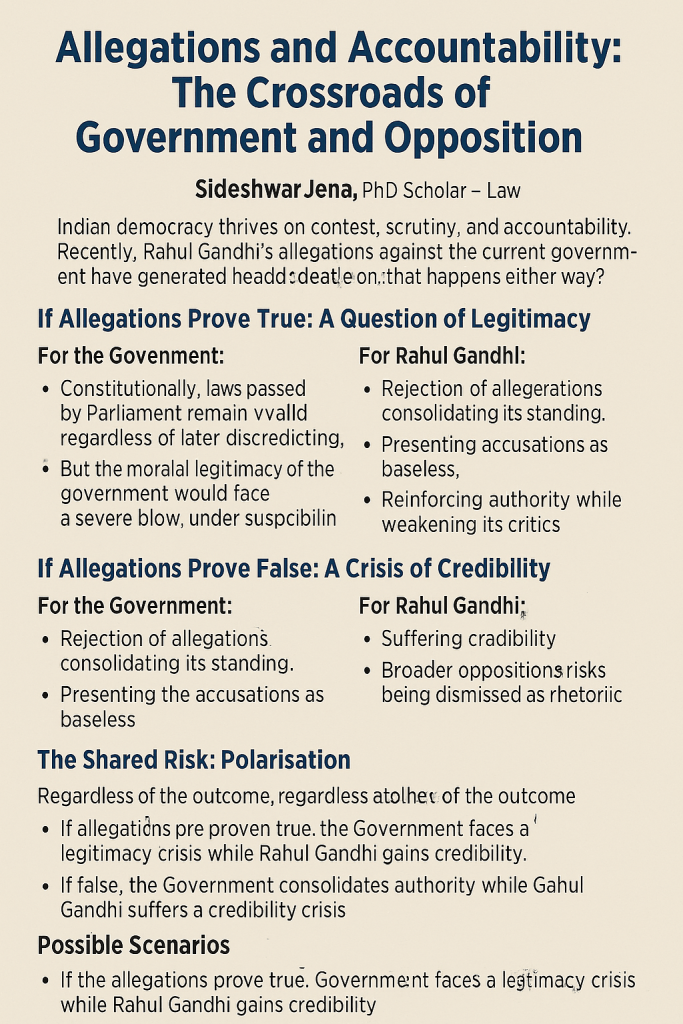
If Allegations Prove True: A Question of Legitimacy
For the Government:
- Constitutionally, laws passed by Parliament remain valid regardless of later discrediting. They can only be repealed by Parliament or struck down by courts.
- But the moral legitimacy of the government would face a severe blow. Policies would be seen less as governance and more as actions under suspicion.
- Critics argue this could deepen political divisions, creating a climate of distrust and instability.
For Rahul Gandhi:
- Vindication would give him political capital and reinforce his narrative of accountability.
- The younger generation, often skeptical of politics, may begin to see him as a credible challenger.
- He would move from being a critic to a leader who stood vindicated against power.
If Allegations Prove False: A Crisis of Credibility
For the Government:
- Rejection of the allegations would consolidate its standing.
- The ruling party would present itself as vindicated, portraying the accusations as baseless.
- This would reinforce its authority while weakening its critics.
For Rahul Gandhi:
- His credibility would suffer.
- The electorate, particularly younger voters, may view him as raising charges without evidence.
- The broader opposition would also weaken, as future criticisms risk being dismissed as rhetoric.
The Shared Risk: Polarisation
Regardless of the outcome, polarisation remains the common danger. Allegations of this magnitude divide citizens along ideological lines, eroding faith in institutions and in each other. Whether the government emerges stronger or the opposition vindicated, democracy suffers if debates do not translate into transparency and accountability.
Here, responsibility lies with:
- The Election Commission of India – to uphold electoral credibility.
- The Supreme Court – to act when constitutional balance is at stake.
- The President of India – as the guardian of constitutional morality.
- The Common Citizen – to demand accountability without bias.
If these actors fail to respond responsibly, then India—one of the world’s strongest democracies—risks long-term damage. It will not just be today’s citizens but also our future generations who suffer.
The Larger Democratic Lesson
This moment reflects a deeper truth: both government and opposition bear responsibility.
- Governments must ensure transparency to prevent suspicion.
- Opposition leaders must back challenges with substance, so credibility is not lost in overreach.
Ultimately, democracy depends less on who wins a political battle and more on whether public trust survives the contest.
Possible Scenarios
- If the allegations prove true: The Government faces a legitimacy crisis while Rahul Gandhi gains credibility.
- If false: The Government consolidates authority while Rahul Gandhi suffers a credibility crisis.
- If undecided: The citizens are the real losers—left with doubts but no answers.
Either way, India’s true test lies in rising above polarisation and ensuring that accountability—on both sides—remains the foundation of its democratic spirit.
 Site Title
Leave a comment