Abstract:
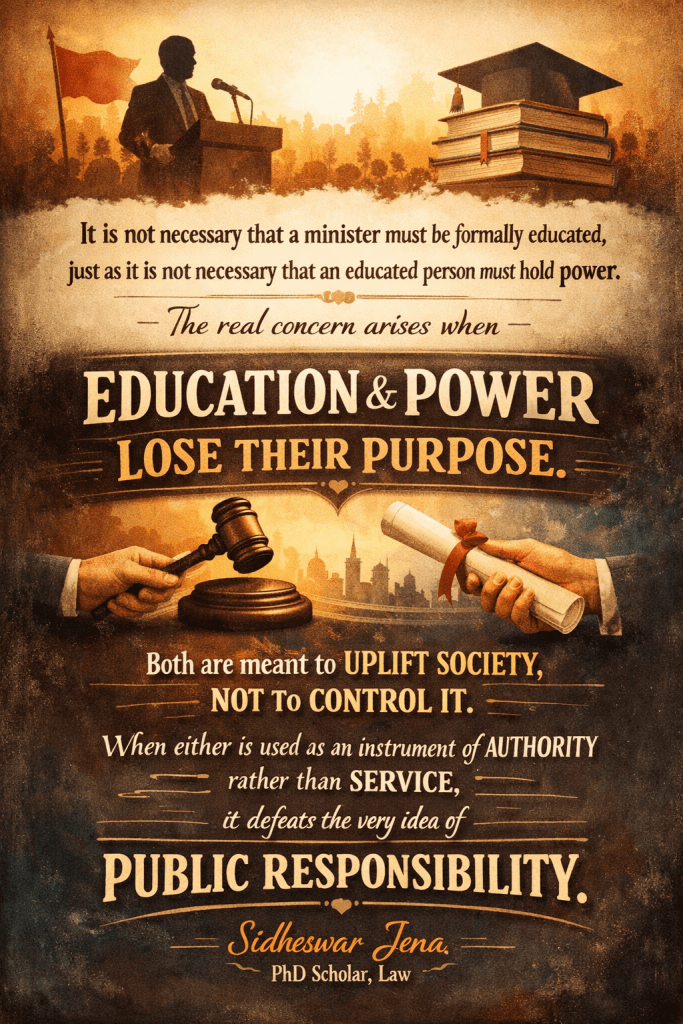
Public debates often focus on whether a minister must be formally educated to govern effectively. This question, though important, is incomplete. Constitutional democracy does not demand that authority flow only from academic credentials, nor does it presume that education alone produces responsible leadership. The deeper concern arises when both education and power drift away from their constitutional purpose. In a constitutional framework, power is not a privilege but a trust, while education functions as a means to cultivate constitutional values such as reasoned decision-making, equality, and accountability. When education is reduced to credentialism and power to command, public responsibility weakens. The Constitution privileges duties over degrees, demanding ethical restraint, transparency, and commitment to public welfare. The paper argues that legitimacy in governance flows not from formal qualifications or authority, but from the faithful discharge of constitutional responsibility toward society.
Keywords:
Education, Political Power, Constitutional Responsibility, Governance, Public Trust
Author:
Sidheswar Jena
PhD Scholar, Law
 Site Title
Leave a comment