By Sidheswar Jena
Ph.D Scholar -Law- Vivekananda Global University, Jaipur, India
India’s education landscape presents a fascinating paradox. On one hand, it produces brilliant minds that lead global tech giants and drive innovation; on the other, millions of students grapple with a system that struggles to deliver equitable, foundational learning. To understand why the Indian education system faces such steep challenges, and why the cultural response to educational success is so intensely celebratory, we must examine the issue through a multi-dimensional lens.
Part I: Why the System Struggles
The challenges within the Indian education system are not the result of a single failure, but rather an intersection of four major structural forces:
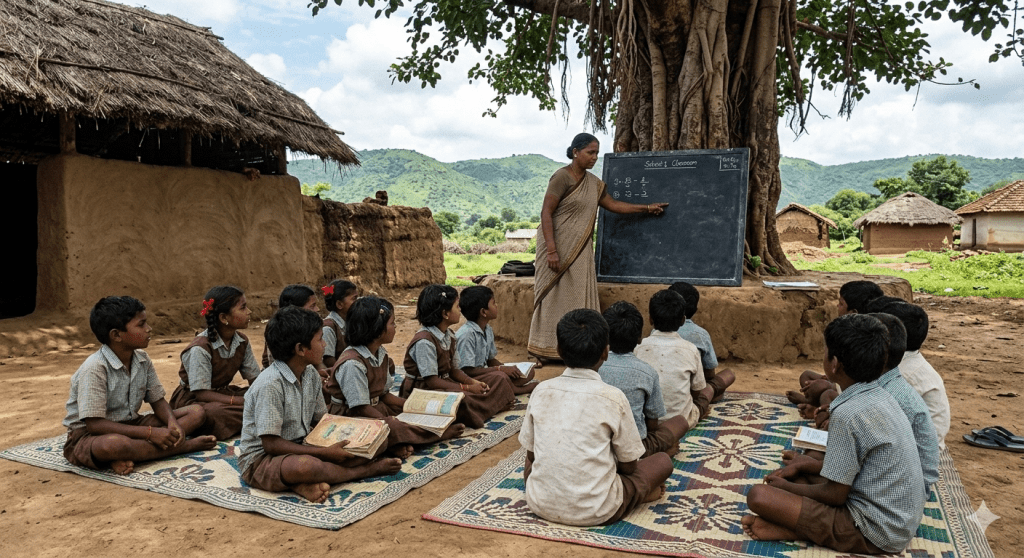
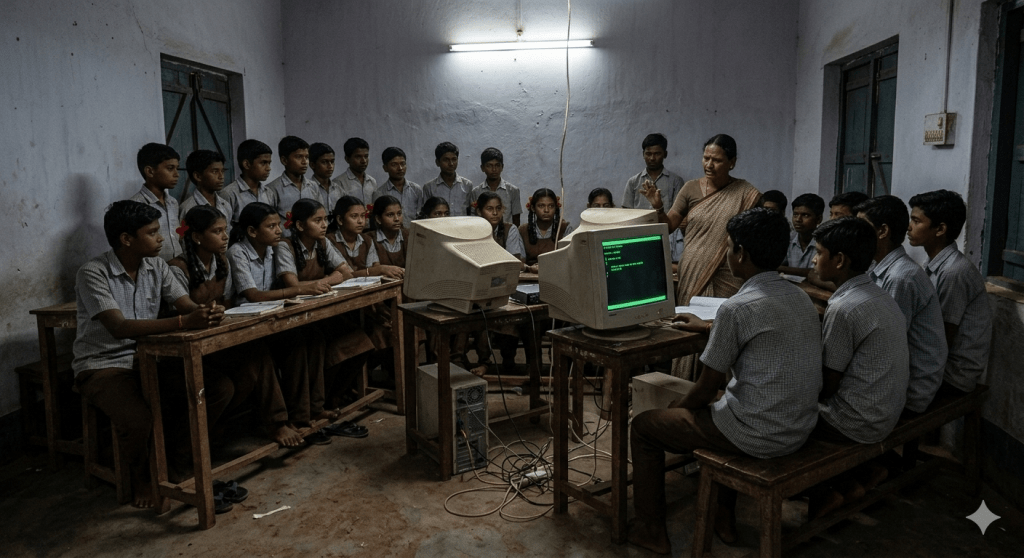
- Economical Deficits: The most glaring issue is chronic underfunding. While modern reforms, such as the National Education Policy (NEP) 2020, ambitiously target allocating 6% of the GDP to education, actual public expenditure has historically hovered closer to the 2.8% to 3% mark. This translates directly to severely under-resourced schools, a lack of infrastructure, and a heavy financial burden on average families who are forced to rely on expensive private schooling to ensure quality.
- Socio-Legal and Structural Gaps: The system wrestles with historical inequalities and a massive rural-urban divide. Furthermore, the traditional curriculum has heavily prioritized rote learning and theoretical memorization geared toward cracking entrance exams. It often fails to equip students with the practical, socio-legal awareness and vocational skills required to navigate and build everyday businesses such as the MSMEs (Micro, Small, and Medium Enterprises) that form the actual backbone of the Indian economy.
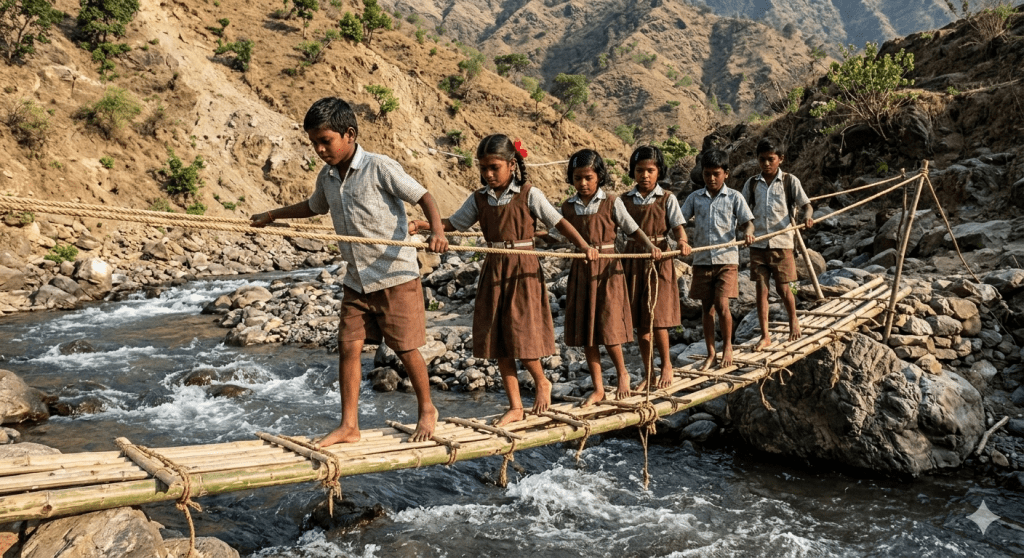
- Geographical Realities: India’s vast and heterogeneous geography from highly developed urban centers to remote tribal belts and mountainous terrains makes standardized implementation nearly impossible. Delivering quality education, maintaining teacher attendance, and providing localized, multilingual content in difficult topographies remain immense logistical hurdles.
- Political Dynamics: Education in India falls under the “Concurrent List” of the Constitution, meaning both the Central and State governments share regulatory responsibilities. This dual control often leads to fragmented policy execution, where a central vision meets political friction at the state level. Additionally, political focus is frequently skewed toward establishing highly visible, elite higher-education institutions rather than fixing the less glamorous, systemic issues at the primary and secondary levels.
Part II: The Anatomy of the Celebration
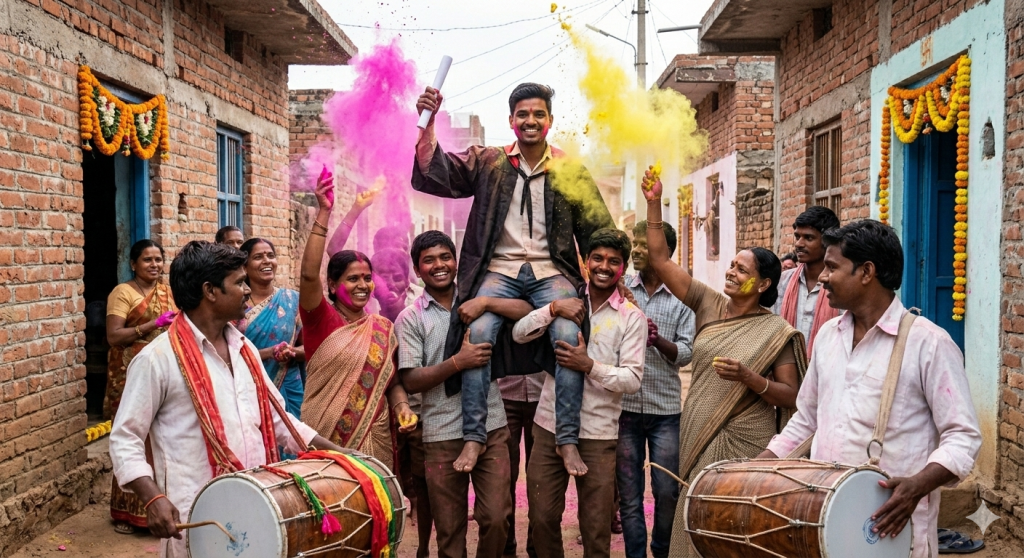
When an Indian student cracks a competitive exam or clears a major academic milestone, the ensuing celebration is famously loud. Is it just for show, a pursuit of social credit, or genuine joy? The reality is a complex, deeply human blend of all three:
- The Genuine Joy of Survival and Mobility: For the vast majority of Indian families, education is not just about intellectual enlightenment; it is the sole legitimate vehicle for upward socioeconomic mobility. When a child clears a critical hurdle like the high-stakes 10th-grade board exams that dictate future academic streams and career trajectories the relief and joy are profoundly real. It represents a family’s collective sacrifice bearing fruit and a tangible step away from financial insecurity.
- Social Credit and the “Status” Currency: In a hyper-competitive society with a massive youth demographic and a severe scarcity of premium opportunities, educational success is the ultimate social currency. Intense celebrations serve as a public validation of a family’s standing. It is a societal declaration that they have successfully navigated a fiercely Darwinian system.
- The Show-Off Factor: There is an undeniable element of pageantry. Because the system is so heavily tilted toward standardized testing, securing top percentiles becomes a spectator sport. Neighborhood sweets, congratulatory banners, and front-page newspaper ads funded by coaching institutes turn personal achievements into public spectacles of pride.
- Deep Cultural Reverence: Historically, the subcontinent has venerated knowledge through the ancient Guru-Shishya tradition. While modern commercialization has altered this dynamic, the underlying cultural instinct to worship the pursuit of learning remains intact. Establishing strong foundational literacy early on such as ensuring a child grasps core analytical concepts by the 2nd grade is viewed by parents as planting a vital seed for future prosperity, making even early milestones a cause for communal pride.
Conclusion
India’s education system is currently in a state of critical transition. Sweeping reforms are attempting to address deep-rooted economic and structural flaws by shifting the focus from rote memorization to holistic, conceptual understanding. Ultimately, the intense celebrations of academic success in India are a direct reflection of a society that knows exactly how difficult the odds are and rejoices fiercely when they are finally beaten.

 Site Title
Leave a comment