By Sidheswar Jena- ESG and Risk Consultant
The tarmac was a searing hot plate. We had set out on a long drive through Keonjhar to explore different parts of Odisha, eager to see the newly opened jungle safari in the Atei Reserve Forest, as well as the Sanaghagara and Gundicha waterfalls. It was a beautiful, sunny day meant for discovery, but by the time we neared the famous Ghatagaon Maa Tarini temple, the afternoon had turned into a furnace. The thermometer read 42 °C, but on the ground, the heat wave felt closer to 50 °C. Because it was a holy place, we had to go barefoot. The ground was so violently hot I could barely put my feet to the road, scrambling and stumbling with every step, just trying to survive the walk into the premises.
But as we pushed through the searing heat, a different kind of harsh reality caught my eye.
Right there on the burning road and inside the temple gates, a crowd of tiny children—bare-bodied, malnourished, looking about two to seven years old—were begging. When my son reached out and handed a currency note to one of the kids, the entire group instantly swarmed us, professional and relentless, reaching out for money.
To prevent a chaotic scramble, I looked at them and said in Hindi, “You all can divide the note among yourselves.”
That is when I accidentally overheard their internal communication, and the veil dropped. We were deep in a region typically far removed from any native Hindi-speaking community, yet these toddlers were conversing fluently and sharply in Hindi. More than the language, it was what they were saying that left me stunned.
One small child turned to another, his voice filled with genuine, calculated anger: “Why did you beg in my line of control? If you keep doing things like this, we will end up damaging our own income!”
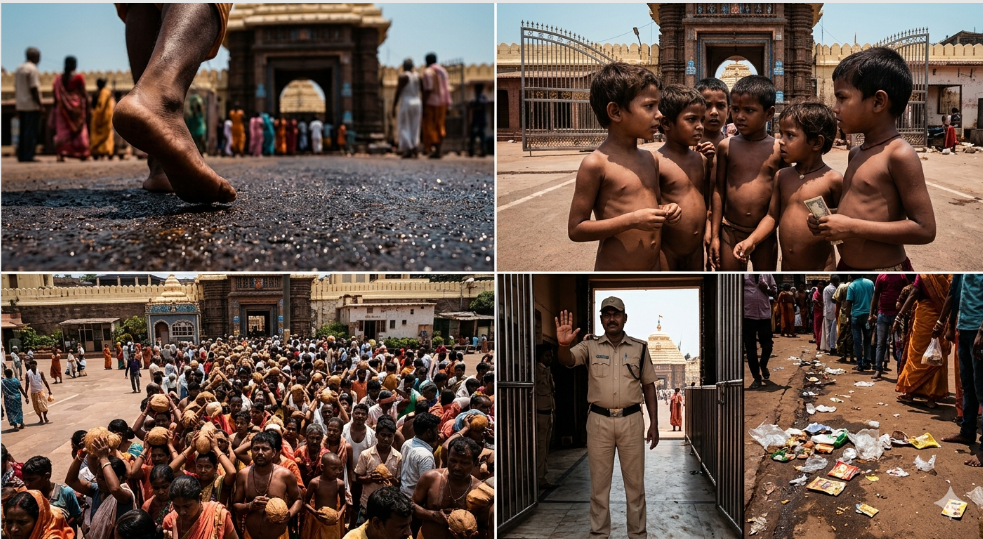
Imagine hearing those words drop from the mouth of a five-year-old. Unknowingly, this tiny child was laying out a highly structured corporate ideology of business ethics, territories, and standards. As I watched and listened to them navigate the crowd, the entire mechanism of the begging industry became crystal clear. They weren’t just random, wandering souls. They were strictly divided into organised groups. Their total income is collected and counted at the end of each day, and they operate under a “master” who manages their logistics and oversees their safety. Breaking a rule—such as encroaching on another kid’s designated area—is treated as a direct violation of their standard operating rules.
What makes their business model truly sustainable is how flawlessly they exploit the surrounding ecosystem with zero capital investment. It is a perfect, scalable matrix. Their “inventory” relies entirely on human psychology; as long as people maintain blind faith and flock to the temple to offer whole coconuts (Narial) in search of a miracle, they will see these bare-bodied, malnourished children and immediately donate out of guilt or pity.
Meanwhile, the risk to their business is absolute zero because the temple completely subsidises their daily survival. The devotees don’t just give money; many actively feed them. The temple’s water taps are open for them 24/7. Free meals (Anna Prasad) are readily available inside the complex every day, and the roadside awnings provide free shelter. They have secured free food, free water, free housing, and a guaranteed stream of customers—all without investing a single rupee of capital.
When we finally managed to step inside the temple itself, the contrast turned deeply ironic and unsettling. I noticed the security guards watching the crowd intently, so I approached one and asked, “Can I take photos inside?” He gave me a stern, immediate no—though, interestingly, there were no restrictions on taking photos outside.
Yet, while the security was hyper-focused on policing cameras, they were completely blind to the utter squalor right under their noses.
The environment inside was unbearable. A terrifying, violent wind was whipping the intense heat wave through the complex, turning the air into a furnace. The entire place was unhygienic, filthy, and completely overrun by swarms of flies. The stench in the air was utterly stomach-churning. Toddlers were pooping openly on the very ground where people walked.
Yet, the devotees were completely unbothered. Blinded by absolute devotion, thousands of people were busy pushing forward, completely oblivious to the flies, the filth, and the stench, caring about nothing but getting a brief glimpse and a blessing from the deity.
I forced myself to take a full round of the premises just to observe the sheer scale of what was happening. It became clear that the temple and the begging children are simply two sides of the exact same coin.
On one side, you have the Tier-1 temple economy. It is an asset-heavy business requiring massive capital investment—building renovations, massive cooking infrastructure for free meals, and water supply systems. They never explicitly ask you for money, but donation boxes are aggressively placed at every single corner. Yet, despite the massive revenue flowing into those boxes, basic cleanliness is neglected, pushed off as something they only do “often when there is a festival.”
On the other side, you have the Tier-2 begging syndicate. They operate with zero capital investment, utilizing the temple’s free food, free water, and physical space as their launchpad, running a highly disciplined, territorial business.
Both entities feed on the exact same raw material: the endless flow of human faith and the human desperation for miracles. Standing there in the sweltering 50 °C heat, watching pilgrims step over filth to offer coconuts while a five-year-old protected his “line of control,” I realized that neither of these businesses will ever suffer a loss. Their sustainability is guaranteed.
The important thing that I observed here is that a business without capital investment has a high chance of scalability. At the same time, it is the devotion of faith that feeds this second business. The primary establishment runs without addressing basic cleanliness or other health issues; for instance, they could have installed overhead shades inside the temple premises to protect devotees from the overhead sun and the blistering ground heat. Yet, here, there are no customer complaints, no customer dissatisfaction remarks, and no return policies—only profit.
The begging business operates on the exact same lines. I am not presenting this as an emotional critique, but rather looking at it through the lens of a Risk and Sustainable Business Consultant. I would definitely say that effective management policies do not always lie within the pages of corporate textbooks. Sometimes, classic studies miscalculate and ignore real-world approaches—approaches that, if properly analysed, could provide a completely different blueprint for organisational management and sustainable business models.
#GhatagaonMaaTarini, #AteiJungleSafari, #ESGNarrative, #SustainableBusinessModels, #MicroEconomicsOfFaith, #ESG, #RiskConsulting, #SocioEconomicSectors, #InformalEconomy, #TempleTourism, #Ghatagaon, #Keonjhar, #OdishaTourism, #BusinessSustainability, #SupplyChainSubsidies, #ConsumerPsychology, #TempleEconomy #SustainableBusiness #RiskManagement #FaithEconomy #BehavioralEconomics #SocialReality #OrganizedBegging #HumanPsychology #InformalEconomy #ZeroCapitalModel #Governance #PublicHealth #DevotionAndCommerce #BusinessEthics #ScalableModel
 Site Title
Leave a comment